


Reflection: Vocation vacation
Saturday August 1, 2026
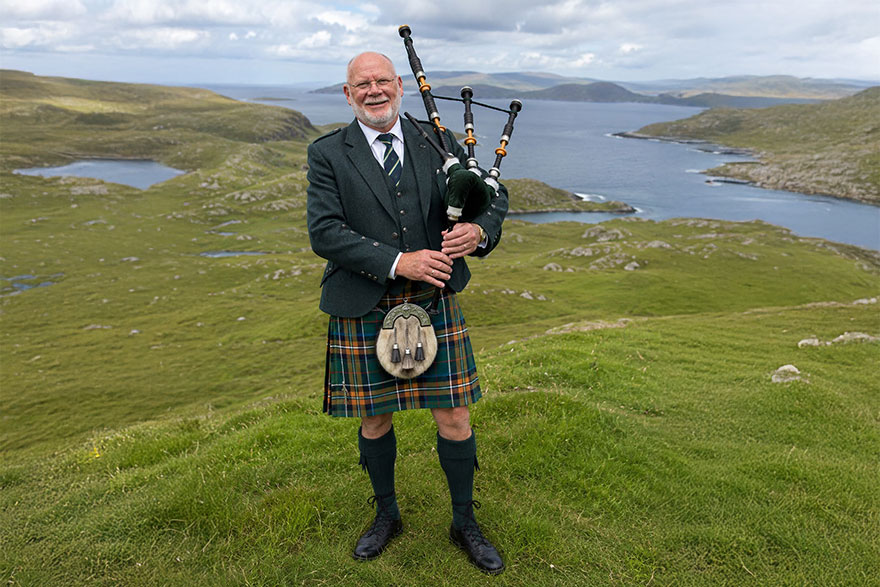
Bhatarsaigh, Scotland.
July was the second time I’ve been to the island of Vatersay, the southernmost inhabited island in the Outer Hebrides. It is five hours by ferry from Oban, off the Atlantic coast of Scotland—the waves were rolling, and I got seasick on the way over. Oban itself was three and a half hours by train from Glasgow. The Scottish mountains and lochs are some of the most beautiful terrain I have ever seen.
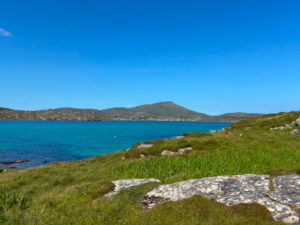
Perhaps most of us take our annual vacation in a social setting, with family or friends, near a population centre or within reach of services and entertainment. When I say Vatersay is the southernmost inhabited island, perhaps I am misleading you. A population of only about 90 people lives in the sparse and scattered cottages of the island. I seldom saw any of them.
In the native tongue of Scottish Gaelic, still spoken here, the island is called Bhatarsaigh. It lies to the southwest of the island of Barra, where Castlebay, the local township, has the only supermarket, two pubs, the parish church, Kisimul Castle—a 15th-century fortified tower house perched on a rock in the middle of the bay—and the ferry terminal.
Vatersay is linked to Barra by a narrow causeway, completed in 1991—the only way on and off the island by vehicle or push-bike. The island of Vatersay is divided by two bays, separated by a narrow isthmus of machair, a low-lying, verdant, grassy meadow growing on a sandy coastal plain. Its highest point is Heishival Mor at 190 metres (623 feet). I liked to go up there and sit in the windy stillness, gazing over the sprawling islands from this high vantage point.
Like Barra, the people of Vatersay are predominantly Roman Catholic, with a deep historical faith that survived centuries of anti-Catholic sentiment in predominantly Protestant Scotland. During my vacation, I stayed in the priest’s house attached to the island’s Church of Our Lady of the Waves & St John, a two-hour walk from Castlebay.
Holiday activity in such a location is fairly limited. I was refreshed each day by slowing down, resting, walking, and catching up on sleep. It is now nine years since I left the silence and solitude of MSC eremitical life to go to Rome. My longing for that interior quiet has only grown stronger and stronger. Vatersay is historically a place of hermits, offering an opportunity for interior attentiveness and conversation.
My dream life became very active. I was often remembering three or four dreams a night. Sometimes the dreams broke into my waking hours, no longer bound by the limitations imposed by alarms or states of consciousness. In my second week, I decided to encourage them and what they were offering by providing seats each morning in the lounge room for central dream characters, Jesus, and myself. Our conversations were incredibly rich and full of clarity.
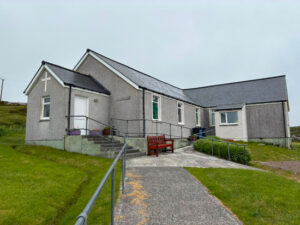
The conversations spilled over into the church, as I would go daily to visit the Blessed Sacrament and take time to chat with Our Lady of the Sacred Heart, or climb the rocks behind the church to share the view with them.
My vivid interiority was enhanced by the faith of the local people who came for morning Mass on Fridays. I arranged with the Barra parish priest that I would celebrate the weekly Vatersay Mass for him. He was very good to me, driving me to the ferry terminal and taking me for a weekly food shop. He is an islander himself. He has five churches spread across Barra and is very involved in the life, culture, and events of the people.
The islanders carry a history that is as deep as the ocean that surrounds them. The sense of the sacred is breathable. Every day, I would sit on the garden seat outside the church, tea in hand, and imagine what had taken place across the green and rocky landscape—there are no trees.
Vatersay was subject to a land raid in 1906 by crofters from Barra and Mingulay. The crofters were very poor Catholic people, working the land and the sea to eke out a living for their families. During a time of great hardship, they left their own islands and took land on Vatersay. In 1878, the whole island had been acquired by a single wealthy landowner living on mainland Scotland.
The crofters were arrested and imprisoned in Glasgow and became known in folklore as “the Vatersay Raiders”. Following their eventual victory in a court case in Edinburgh, the Government was forced to buy the island at inflated prices to regularise the situation, and the raiders returned to the island and settled there.
The island is a constant reminder of perseverance, Providence, and profound trust—a faith forged by the sea, strengthened in community, and courageous enough to risk everything for the promise of a future.
Outer history echoes interior story.
Chris Chaplin, MSC. Australian Province