


Reflection: A call to discernment in unity
Saturday September 5, 2026
The Transfiguration and the 40th anniversary of the UAF.
On this Feast of the Transfiguration of the Lord, we give thanks to God for the forty years of existence of our Union of Francophone Africa (UAF), founded on 6 August 1986. This happy coincidence invites us to revisit our history in the light of the Word of God.
On this day of remembrance and thanksgiving, we also wish to pay a grateful tribute to Father Karl Hofer, MSC, the first Superior of the UAF and the architect of its founding. Following the decision taken by the 1985 General Conference at Douglas Park, Australia, to establish a separate entity for the missions in Francophone Africa, he embraced this vision with faith, courage and a missionary spirit. His commitment, together with that of many of his fellow Missionaries of the Sacred Heart who were there from the very beginning, laid the solid foundations of our Union. Forty years on, we owe them our deepest gratitude for their foresight, their generosity and their confidence in the future of the mission in French-speaking Africa.
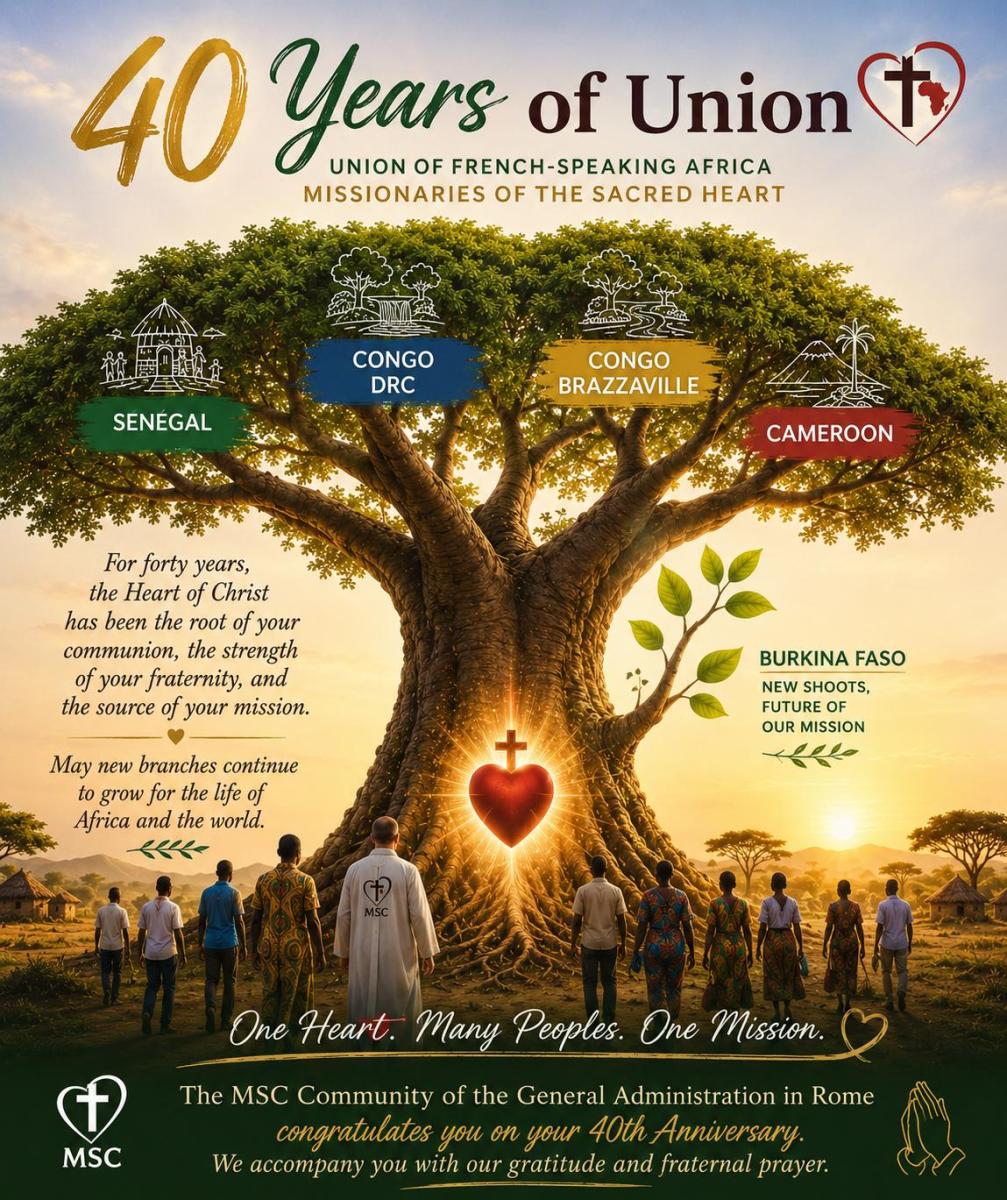
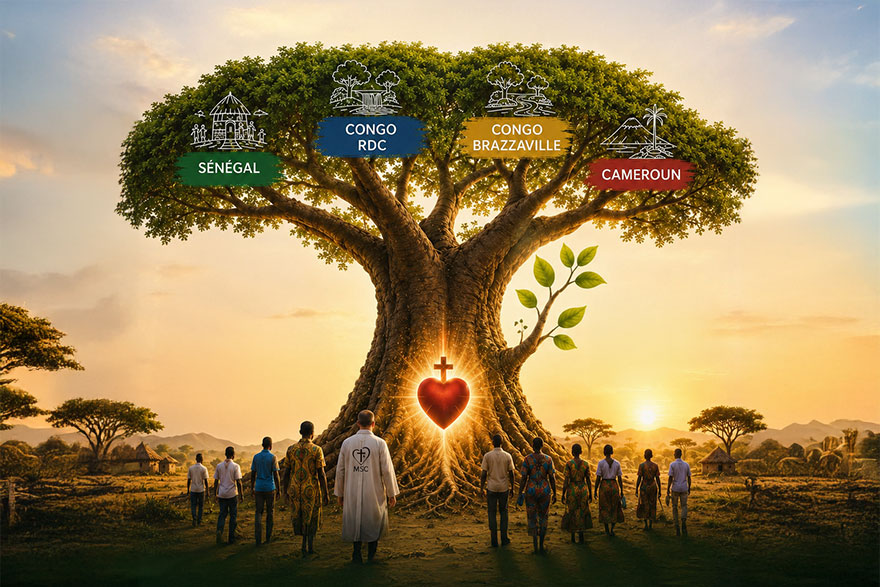
In the Gospel of the Transfiguration (Mt 17:1–9), Peter exclaims: ‘Lord, it is good that we are here. If you wish, I will put up three tents here: one for you, one for Moses and one for Elijah.’ Peter’s suggestion reflects his desire to preserve this exceptional moment. It can also inspire us to reflect on our current reality. The three tents symbolically remind us of our three districts: the Congo, Cameroon and Senegal. For years, these districts have carried out the UAF’s mission with generosity and fidelity. They are the fruit of a long journey of faith, sacrifice and hope.
But the Gospel does not stop at the three tents. A voice is heard: ‘This is my beloved Son; listen to him!’ Then Jesus approaches his disciples, touches them and says to them: ‘Get up and do not be afraid.’ Finally, when they look up, they see only Jesus alone.
This final image deserves our particular attention. After the extraordinary signs, after the figures of Moses and Elijah, after the three tents, only Jesus remains. It is he who refocuses on what is essential. Their gaze must not be fixed first and foremost on structures, but on the person of Christ and the mission he entrusts to them.
Today, forty years after the foundation of our UAF, several questions naturally arise. Is the evolution of our districts into one, two or three Provinces a sign of maturity? Is it a necessity to serve the mission more effectively? Or should we first ask ourselves how to preserve and strengthen what constitutes our common identity as a Union?
This is not a matter of pitting the Union against the future Province, nor of questioning the motives of those reflecting on this development. The creation of Provinces may meet genuine needs for growth, proximity and governance. But it should never lead to a weakening of the fraternal communion that has united us for forty years.
The fact that the disciples see nothing but Jesus reminds us that our primary allegiance is to Christ. If we keep our eyes fixed on him, our institutional choices, whatever they may be, will always serve the Gospel. If, on the other hand, we risk prioritising local interests, regional sensitivities or administrative considerations at the expense of communion, we could lose sight of what is essential.
We can also apply Jesus’ words to our UAF: ‘Stand up and do not be afraid.’ They are a call to look to the future with hope. Structural changes must never be guided by fear, but by spiritual discernment, lived out in trust and in the pursuit of the common good. Whether it is a matter of remaining a strong Union or evolving into several Provinces, the fundamental question remains the same: which choice will best serve the mission entrusted to us by Christ?
As it marks its fortieth anniversary, the UAF is called not only to look back with gratitude on the path it has travelled, but also to discern with wisdom the path that lies ahead. Any changes to our structures should strengthen our ability to proclaim the Gospel, to live in brotherhood and to bear witness to our shared charism. The Provinces of tomorrow, should they come into being, should not be isolated entities, but living expressions of a shared history, a shared spirituality and a shared mission.
Finally, the Transfiguration teaches us that the disciples did not remain on the mountain. They came down with Jesus to continue the mission. Similarly, the UAF cannot remain stuck in nostalgia for its past or merely in contemplation of its successes. It is called to move forward with confidence, to listen to Christ and to walk together.
On this fortieth anniversary, let us ask for the grace not to be blinded by our institutional concerns, but to have a vision enlightened by Christ. May he grant us the grace to listen to his voice, to discern his will and to make the choices that will further build up communion. For, at the end of our reflection, like the disciples on the mountain, may we lift up our eyes and see only Jesus, alone, our one Lord and the foundation of our unity.
This is undoubtedly the finest legacy left to us by the pioneers of the UAF, beginning with Father Karl Hofer, MSC: teaching us that structures are at the service of the mission, but that the mission itself finds its unity only in Jesus Christ. If we remain centred on him, then the future of our Union, whatever institutional forms it may take, will always be a future of hope.
Simon Lumpini, MSC. UAF