


To Form or to Be Absent
Wednesday July 1, 2026
Prayer and Mission as the Soul of Formation
In the face of the many challenges marking ecclesial and institutional life today, initial formation stands out as an essential priority. The vitality of vocations, the solidity of commitments, and the credibility of missionary witness largely depend on it. It is therefore timely to revisit certain fundamental aspects of formation, particularly the place and role of formators within houses of formation.
At the heart of religious institutes, houses of formation occupy a strategic and decisive place. They are privileged spaces where vocations are nurtured, where deep motivations mature, and where the meaning of consecrated and missionary life gradually takes root. More than places of intellectual preparation, they are schools of discipleship where young people learn to unite prayer and mission in daily life.
In this light, a question must be raised with clarity and responsibility: what is the real quality of the presence of formators in our houses of formation today?
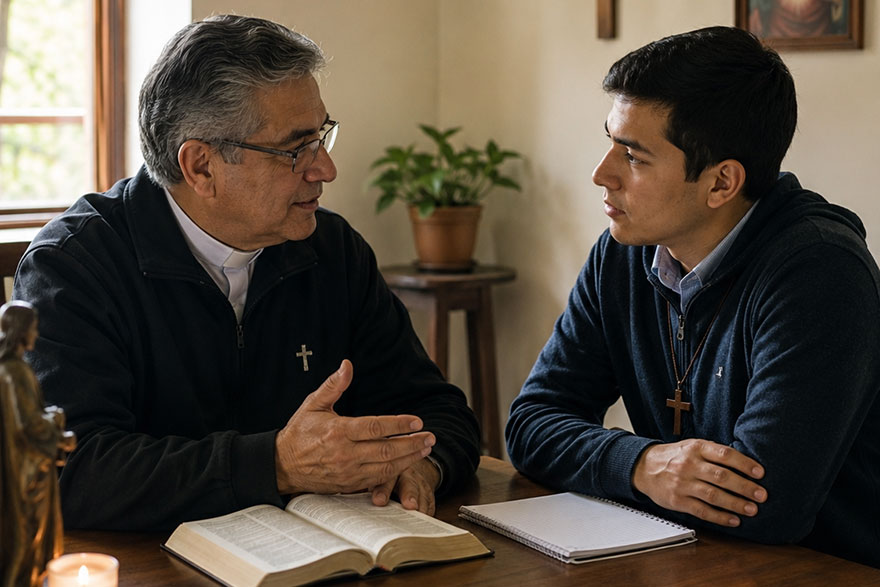
Formation does not consist merely in transmitting content, organizing programs, or ensuring academic follow-up. It is, above all, a spiritual and relational experience. It is grounded in presence: a stable, attentive, prayerful, and available presence. A presence capable of listening, accompanying, discerning, and guiding. A presence which, through its fidelity and coherence of life, becomes a living witness and a structuring point of reference for those in formation.
A formator is not simply an administrator or educator; he is first a man of prayer and mission. His availability to those entrusted to him must flow from his own communion with Christ. Indeed, authentic formation can only emerge from hearts transformed by prayer and rooted in the Gospel.
Yet, in many situations, this essential presence is weakened. Formators are often called upon to assume multiple responsibilities, leading them to divide themselves among various missions. Without questioning the legitimacy of these commitments, it must be acknowledged that such dispersion has concrete consequences: it reduces availability, weakens continuity in accompaniment, and ultimately impoverishes the formative process.
The Emmaus document, in number 48, expresses a clear guideline in this regard:
“Formators should not have other activities outside the house of formation.”
This statement reflects a fundamental requirement: the mission of formation demands full and undivided availability. It cannot be carried out partially or intermittently without compromising its effectiveness.
A formator is not simply an administrator or educator; he is first a man of prayer and mission.
Accompanying a vocational journey requires time, consistency, and genuine closeness. It calls for entering processes that are often long and complex, welcoming fragilities, supporting growth, and fostering authentic discernment. Such accompaniment also requires spiritual availability nourished by prayer. A fragmented presence cannot adequately respond to these demands.
The quality of formation depends not only on structures or programs, but also on the spiritual atmosphere within the house itself. A true house of formation is a community where prayer, fraternity, silence, discernment, and mission are lived concretely every day. Formators play a decisive role in creating and sustaining this environment.
The question of the availability of formators thus directly challenges those in positions of governance. Appointment to a formation mission cannot be considered as one responsibility among others. It requires a clear choice, appropriate conditions, and prioritized commitment.
To assume formation as a central mission means concretely ensuring that formators can dedicate to it the necessary time and energy. This implies, whenever possible, limiting external responsibilities that may disperse their attention and compromise their effective presence within the house.
This reflection does not ignore real constraints or limitations in available personnel. Nevertheless, it remains essential to maintain a proper hierarchy of priorities: what is decisive for the future cannot be treated as secondary.
A house of formation is not defined first by its buildings or programs, but by the quality of the life lived within it. This quality depends largely on the presence of the formators, their capacity to share daily life, sustain a climate of prayer, accompany personal journeys, and build relationships of trust.
A real and committed presence helps to structure, secure, and energize the formation process. Conversely, insufficient presence, even if unintentional, can create fragilities and gaps that are difficult to compensate for later.
In the current context, marked by new challenges and increasing expectations from those in formation, the quality of accompaniment is more decisive than ever. Young people need formators who are available, spiritually grounded, and deeply rooted in their mission. They need witnesses whose lives reflect the harmony between contemplation and apostolic service.
Formation is not a secondary mission: it concerns the future of the Church and of the Congregation.
Those in positions of responsibility, particularly provincials, have the duty to ensure a real, stable, and prayerful presence of formators. The requirement recalled in the Emmaus document (n. 48) calls for concrete and courageous decisions.
To form requires being present.
To accompany requires praying.
To educate for mission requires first living from communion with Christ.
Only under these conditions will formation truly bear lasting fruit for the mission of the Church.
Simon Lumpini, MSC. UAF