


Working towards communion
Wednesday April 8, 2026
No mission is possible without fraternal communion
Values such as fraternity, communion, justice, peace and integrity of creation are of great importance today. We live in a world marked by violence, a world that is suffering and threatened, but also full of promise for life, a world thirsting for peace and true fraternity.
Fraternity in the Church is not just a value but is constitutive of its nature and therefore also of its own identity; it is not possible for it to envisage its mission outside this reality. The community of the first disciples of Christ remains the model for every community in the Church. The members of the apostolic community knew how to appreciate community life and enjoy the pleasure and joy of being together (Acts 2:46). They lived in unity of heart (Acts 4:32).
Communion among us is not an option. It is our vocation. The fraternal life to which we aspire is rooted in our vocation to communion. It remains a daily challenge. ‘The same vocation and the same mission bring us together in community. It is the expression of the very communion of the Church, a communion of faith, love and worship in which all are children of God, brothers and sisters in Christ. Our community life must bear witness to this reality.’ (CS MSC 30).
We know that this communion between us goes beyond simple natural friendship. It is not the result of some kind of alchemy. It is a gift from God. We must humbly ask God for the gift of unity.
But it is also a choice we must make; we cannot simply ask for the gift of unity and remain passive. ‘Seek unity,’ says St Paul (Phil 2:2), who was well aware of the risk of division within Christian communities. The devil is at work, and we must work for unity with perseverance and diligence. ‘True community is not given once and for all. It grows through God’s grace and the constant effort of each person. It must be built up every day to become a community of faith and love through prayer and the Eucharist, and the sharing of the Word of God…’ (CS MSC 35).
Are we ready to work for communion among ourselves? The challenge is great. From a human point of view, how many differences there are between us! We are different in age, social background, cultural origins, personalities, community realities, interests, places of formation, personal and community histories… ‘Grateful for the diverse gifts that we and our cultures have to offer, we perceive the challenges and opportunities contained in our differences: they are an invitation to fruitful cooperation, [communion] and collaboration…’ (Cf. CS MSC 33).
As MSCs, we have a witness of brotherhood to give. For communion is a necessity for mission: ‘so that the world may believe that you sent me,’ says Jesus (Jn 17:21). Our divisions are an obstacle to evangelisation; they discredit the proclamation of the Gospel. Our unity comes from God and is consolidated in mission. Whether within our religious communities or in our mission fields, the awareness that we are all involved in the mission makes us look in the same direction and strengthens our unity.
It is often said that unity should not be confused with uniformity. Diversity is not, in itself, an obstacle to unity, provided that we do not make our differences markers of identity. This is a phenomenon that can be observed in society and which, to some extent, is natural. Let us be careful not to turn it into a source of tension, and, above all, not to judge people on that basis. For the sake of unity, let us not exaggerate our differences and let us be able to see what is good in the way others do things. Where our differences have created divisions, let us strive to bridge the gap!
Where do we stand in terms of fraternity in our religious communities? Are we not invited to question ourselves about our community life? This is what makes up the dynamism of our missionary life, whatever our age today.
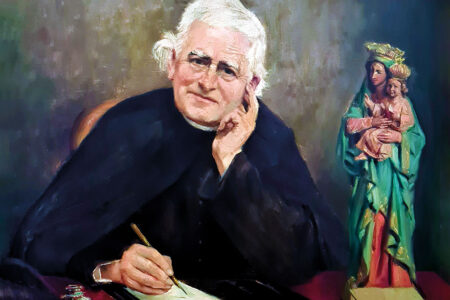
Following in the footsteps of Father Jules Chevalier and all those who have gone before us, we continue to build up the Congregation through our words, our actions and the witness of our whole lives. We have a mission to embody and manifest among ourselves the human values of the Heart of Christ: tenderness, gentleness, compassion, kindness and mercy. It is together, in community, that we live our religious life, in personal commitment and responsibility. The vigour of our community life depends on the time invested and the means taken to forge fraternal bonds and maintain genuine interpersonal and community relationships. (Cf. CS MSC 34).
We need to experience powerful moments that unite us, to share our experiences of faith, to celebrate reconciliation on a daily basis, freely. Sacrifice, trust, respect, openness, dialogue, availability and mutual attention are of great help. Our MSC communities are called to be places where we can experience the joy of being together. (Cf. CS MSC 32). Each of us can foster the development of the gifts of others, rejoice in what they bring that is unique, and even more, in the precious gift that they represent for the community.
Our common mission in community life commits us to building quality fraternal relationships among ourselves. Events in the world and in our different countries challenge us and invite us to persevere in fraternal love. They are a call to live communion among ourselves to the full, and to participate in building more humane societies through the witness of our community life.
We are workers. And workers work according to a basic plan that they consult often. Our basic plan is the Gospel and our MSC Constitutions and Statutes. It is good that we often glance at this basic plan in order to move forward on the path of fraternal communion. “As we all know, our Constitutions and General Statutes are a book of life that reflects our identity, our mission and the path we are called to follow as an MSC Congregation. They are not simply a set of rules and norms. May this revised version be a living instrument that strengthens, unites and guides us on our journey in the footsteps of Jesus, as we walk together with hope, fervour and commitment.” (Fr. Mario Abzalón Alvarado Tovar, MSC, Superior General, Letter of 15 February 2025)
The experience of fraternity is not limited to the religious community. It extends to everyone. Do not lay people express a desire to share our spirituality of the heart and our mission? The very understanding of the Church as communion is an invitation to exchange with one another, to support one another on the path to holiness and to give a more concerted and appropriate response to the needs of today’s world.
Finally, let us pray with this prayer written in 2020 by Fr. Daniel Auguié (Provincial of France/Switzerland)
Lord Jesus Christ, in the love of your Father and the communion of the Holy Spirit, you have chosen and called us to be missionaries of your Heart.
You want us to be the Heart of God on earth.
To renew and strengthen our mission: give us today
your spirit of love, that it may inspire in our heartsa fraternity open to all, where each person recognizes that they are loved
and capable of loving in return.
Servant of God Jules Chevalier, pray with us and for us. Our Lady of the Sacred Heart, accompany our missionary steps on this beautiful path of fraternal communion.
Jean Noël FAYE, MSC. UAF