


Reflection: Where is God in all this?
Friday December 26, 2025
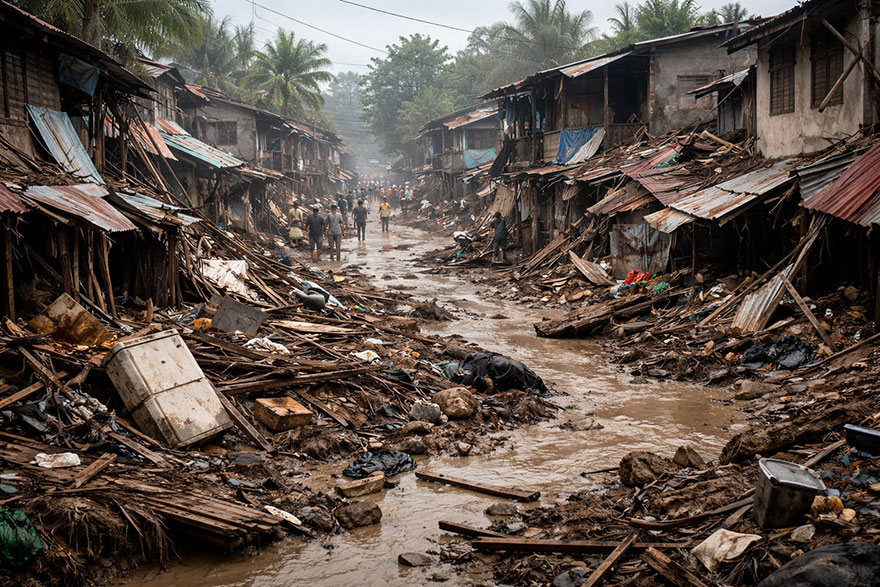
Humankind has inflicted pain, suffering, and violent deaths on itself in plentiful proportions, especially in the 20th century and continuing in the 21st century. We have been in crisis with the unnecessary killing of innocent human beings through war, mega murders, genocide, poverty, starvation, and other forms of violence. Government-sanctioned murders of innocent individuals have reached the mark of over 169 million since the pre-20th century. These horrific actions create a miserable state of affairs and deny any purposeful and meaningful existence. They can induce a profound spiritual crisis of faith in a loving and caring God.
For some, the crisis leads to complete disbelief. Inevitably, we ask: Where is God in all this? Where is the presence of God in the midst of so much suffering among his people? Why does God allow so many innocent individuals to suffer from the world’s different social ills? These queries were brought to the forefront during the Jewish Holocaust, not only from Jews but from Christians as well. They continue to be asked in the present day. In a sense, the answer is unknowable. God’s will is ultimately a profound mystery. Still, such questioning cannot be ignored. The innocent victims who experience unbearable suffering deserve a response.
Answers such as “God is testing us” or “This is God’s will or punishment for sins” do not seem to be satisfactory answers for the victims, nor for the modern conscience. It’s difficult to believe that God continues to make his sons/daughters suffer gravely while telling us, “I’m testing you. I love you. That is why this is happening to you. The more you suffer, the more I love you.” Stating that God willed over 61 million persons to be savagely murdered under the Soviet Gulag State can hardly ease the victims’ conscience and the pain from the loss of loved ones. It is even more horrifying to claim that God, a God of love, willed these things. Additionally, punishment for sins cannot hold as a convincing argument for the innocent, especially the children who must endure so much misery.
Another answer comes from the idea that we were created on this earth to suffer. If this belief were true, then there would have been no need for Christ “to proclaim liberty to captives and recovery of sight to the blind.” (Luke 4:18). While suffering is an inevitable part of life, it is more reasonable to believe that God created us out of love, not for the fixed purpose of suffering.
During the Jewish Holocaust, there was a cry to God for liberation from the Nazi oppression. Their lament surfaced from the deep recesses of their hearts. Some harboured intense anger towards God, questioning how He could permit such atrocities to befall them. God had become deaf to the cries of humanity. In their anguish and torment, they believed that compassion and justice had departed from the earth. A significant number of Jews lost their belief in God. Following their liberation from Nazi rule, some Jews held the belief that God, not Hitler, should face legal proceedings.
Sentiments such as these continue today. God is to be placed on the docket. His people play the role of plaintiffs. Believers are quick to criticise this courtroom analogy, but if placed in the proper context, it can be cathartic for the release of much built-up anger and hostility. The legal system can be a legitimate means to vent one’s anger, despair, and agony and to seek answers to questions deep within the heart. In the Old Testament, Job can be described as the plaintiff, questioning the defendant, God. Micha also has God in the courtroom.
Challenging God can be a legitimate expression of one’s anger. This is not contrary to the spirit of the gospels. Martha’s words were, in a sense, a challenge to Christ when he arrived at her house after Lazarus’ death: “Lord, if you had been here, my brother would not have died.” (John 11:21) The Canaanite woman challenged Jesus after he initially refused to cure her, saying, “Please, Lord, for even the dogs eat the scraps that fall from the table of their masters.” (Matthew 15:27) This could have been a wake-up call to the human Jesus.
So where is God in all this? Where is the God of love and compassion and the liberator of mankind in the midst of so much unnecessary suffering? Despair and hopelessness, along with rejecting God due to doubt, are not the answer. Both the Old and New Testaments have an extraordinary and powerful truth about God’s presence in human tragedy. The truth is that God is present in our suffering brothers and sisters. God does not abandon His people. God is the humble One who appears in a lowly bush on a mountain in the wilderness rather than on a king’s throne in a majestic forest. God can always be found with the lowly. The Incarnation attests to the fact that God is one who places limits on Himself in order to be one with His people. In Christ, we see a heart that shares in the sufferings of his brothers and sisters. This meek and humble heart not only cries to the Father for liberation from the evils inflicted upon the human family.
The Incarnation is the most visible reality of God, who empties Himself to be in solidarity with God’s people. Jesus is beside the suffering human family. Alongside his brothers and sisters, his heart also yearns for freedom from evil. In Jesus, the Powerful One becomes powerless. If Christ is present among the persecuted and oppressed innocent, where then is there a resurrection? We can inform them that their sufferings will end because there will be a resurrection in the life hereafter. This, however, can be a simplistic response that can hold back responsibility and action on the part of the Christian community.
The Irish philosopher and statesman Edmund Burke said, “The only thing necessary for the triumph of evil is for beneficial men to do nothing.” It is fascinating to see how people around the globe unite in solidarity to help those victims of natural disasters, but there always seems to be a majority who remain silent when humans perpetrate evil actions that place others in deadly peril. The majority of people in Russia were pious and peaceful Christians, but an insufficient number spoke out against the killing of over 61 million minorities in the Soviet Gulag State. The majority of people in China were good and peaceful people, but tacitly complicit when over 35 million of their people perished from the Chinese Communist Ant Hill.
Over 20 million murders occurred under the Nazi regime, despite the presence of good and peaceful people. With a majority of beneficial and peaceful people present, Japan’s savage military killed over 5 million. The mass murders of the Khmer Rouge, Turkey’s genocidal purges, the Vietnam War, Poland’s ethnic cleansing, Pakistan’s cutthroat state, Tito’s slaughterhouse, and North Korea can be included, where the majority of the people were charitable and peaceful, but only a courageous minority of them took action to end the destruction of human life. The same can be said about local communities in which the majority who are charitable take no action against violence and deaths inflicted on innocent life.
Faith in Christ impels his disciples to action. It is the Christians’ obligation and responsibility to act as witnesses to the Gospel, not only in thoughts and words, but essentially in deeds. For “if anyone is a hearer of the word and not a doer, he is like a man who looks at his own face in a mirror. He sees himself, then goes off and promptly forgets what he looks like…faith of itself, if it does not have works, is dead” (James 1:22-24; 2: 17; cf. Matthew 13:1-9, 18-23).
We cannot meet the tragedies inflicted upon humanity today in silence. Witness to the Gospel is an act of love and justice that establishes the truth of God’s presence in the world. Christ, through the Holy Spirit, manifests in the Christian testimony of liberation to renew the earth per the Father’s will.
Warren Perrotto, MSC (USA Province)